A space for reflection

Author: cheg (Page 1 of 2)

Teaching in 2040

Jim Morrison once sang the famous line: “the future’s uncertain and the end is always near” in one of The Doors’ most iconic songs Roadhouse Blues. I love this quote, and I often find myself thinking about it. In tech class, we were encouraged to imagine ourselves teaching in the year 2040. I’ll be honest: I have no idea what to expect when it comes to teaching in 2040. Will the climate crisis change the focus of lessons and courses? Will the climate crisis change the way students are taught (synchronously vs asynchronously?) Will technology be so advanced that it will mark the end of the current era of teaching and the current classroom design as we know it? While I ponder all these questions, my mind relates back to that Jim Morrison quote. Now, I don’t believe this Rockstar poet wrote this quote with the school systems in mind and the evolution of education in mind, but art, and by extension, lyrics, are up to interpretation, right? For the sake of my interpretation of this lyric, I’ll be analyzing how it relates to the theme of uncertainty and the end of an era in a classroom setting.

Screenshot taken by chegruns of Amazon Music: “Roadhouse Blues” by The Doors

The Future’s Uncertain…

The climate crisis gives me a lot of worry and fear and uncertainty with respect to the future. I cannot help but imagine this topic will have a major influence in a classroom setting. For one, I would imagine topics might be more cross-curricular in a way that relates courses to the climate crisis: data analysis and trends of climate change in math, ecological damage and its impact on the climate in biology, energy efficiency in chemistry/physics, and human impact on the climate crisis in socials studies, for example. Secondly, I expect there may be an expectation that people are doing their part to significantly reduce their carbon footprint, more so than ever. This may result in more asynchronous/remote learning (where students aren’t having to commute to school), more digital resources (e-books and online textbooks instead of printed copies), and overall different expectations in a school setting with respect to waste reduction and recycling. However, I still feel uncertainty with respect to this as it likely depends on the actual impacts of the climate crisis as they play out, as well as factors such as to which extent the climate crisis is considered a serious threat to our future.

…and the end is always near

We have witnessed the evolution of technology over the past few decades, and I think it would be an accurate prediction to say that based on the trends of technology advances that have occurred up to this point, it will be even more impactful in 2040. I foresee a future where basic classroom resources such as printed books, paper, and pencils may not be such obvious, typical elements as tablets and electronic reading resources become much more accessible and typical. I foresee a future where teaching may very well be conducted online, as technology advances to such an extent that the current classroom design could essentially be “mimicked” online. Will this mark “the end” of the era of classrooms, teaching practices, and general school design as we’ve always known it to be? Maybe not completely so by 2040, but I sense the end of this era will be near by then.

An online class. Screenshot taken by chegruns of photo from PowerPoint. Photo by unknown author is licensed under CC BY Creative Commons — Attribution 3.0 Unported — CC BY 3.0

Coding In the Classroom

In tech class, we discussed coding and how it can be integrated into the classroom. I am a math person, and often times people associate coding with mathematics, based on their common skills in logic, algorithmic design, and problem solving. However, for myself, to say that I developed competent skills in coding during my math degree would be a lie! I’m horrible at coding, and I don’t enjoy it at all. I do, however, believe it is an excellent resource, mode to represent your work, and tool to apply your learning in the math and science based classrooms. With a bit of motivation, I’m sure I could apply myself and learn to use it successfully and come to appreciate its implementation.

Despite my overall negative experience with coding during my undergraduate degree, I do have some memorable, somewhat positive takeaways to share.

RStudio for Statistics: In my statistics courses during my undergraduate degree, creating plot diagrams to support our data was a significant portion of coursework. Thankfully, there is a programming language called R which makes it pretty simple, even for non coding individuals, to create the plot diagrams instead of needing to do them by hand. During my undergraduate degree, I used RStudio to access the R programming language as it was organized and user friendly. Below is a video which describes why RStudio is a great option for R users:

Video from YouTube user MarinStatsLectures-R Programming & Statistics

Python’s Math Functions: During my undergraduate degree, I had to take a course on computer assisted mathematics and statistics. In this course, Python was the programming language used. This programming language made this course so much simpler because of Python’s math library! By typing something as simple as “import math” in the python console, you have access to all of the created math functions within the python language, without having to create them yourself! This is especially awesome when the goal of the course is not to be tested on the student’s ability to perform the math required for a given function (this should be done in other math courses), but rather to focus the questions on data analysis, and expose students to the different tools available to them to represent their work! Below is a video which describes how to use and access the math functions within Python!

Video from YouTube user Telusko which discusses how to use the math functions in Python

I hope that these options described above help students that don’t have the most positive relationship with coding learn to appreciate it a bit more and realize that there are ways to use it successfully and productively in their math and science based classes!

2021 Royal Victoria Half Marathon: A Recap Of The Best Race I’ve Ever Run!

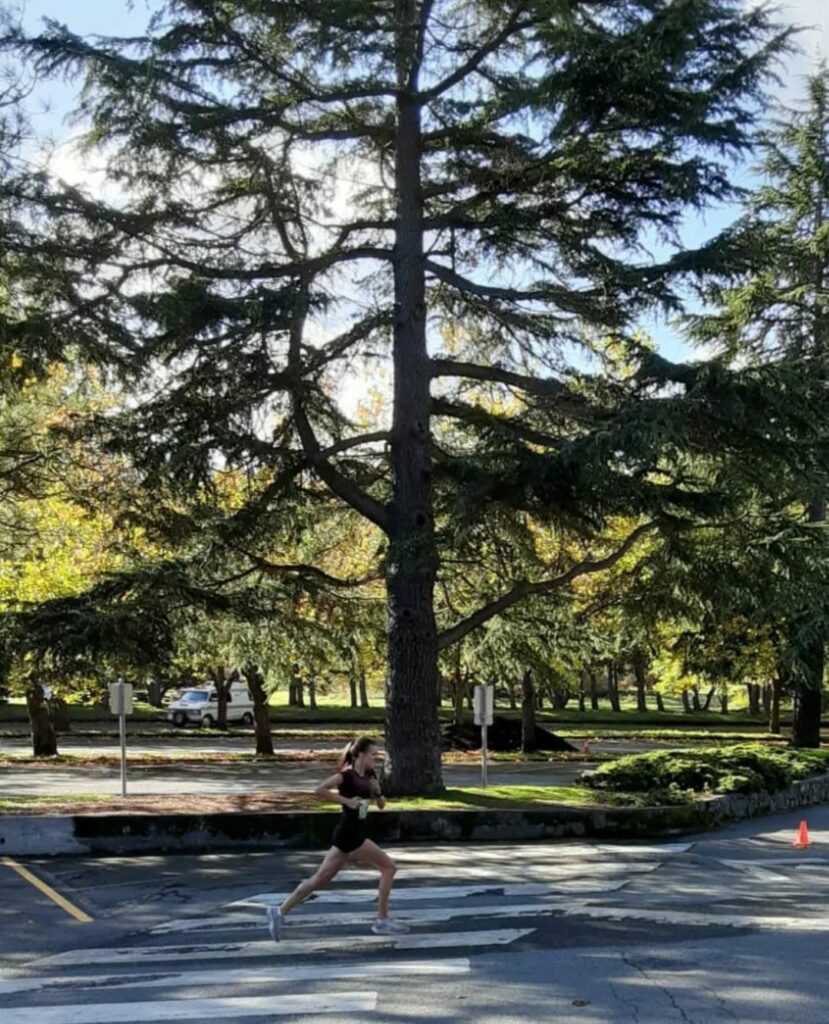
Working hard in the last ~5km of the race

On Thanksgiving Weekend in 2021, I participated in the Royal Victoria Half Marathon. I was very excited for this race for a number of reasons:

  1. It was going to be my first race since the start of the pandemic (nearly 2 years away from racing!) Racing isn’t my favorite thing about being a runner, but when races come but once every couple of years, they are pretty exciting!
  2. I had trained very specifically and consistently for the half-marathon for a full year leading up to it. Tempo runs, long runs, progression runs, and hill runs were a major part of my training in 2020/2021, so I felt pretty in tune with the rhythm/effort of half-marathon pace.
  3. As a result of my extended preparation for the race, I felt very confident in my fitness and in my ability to perform to my potential. It was a great feeling to go into a race feeling nerves as a result of wanting to showcase your hard-work and preparation rather than feeling nerves from a lack of confidence in your training and your ability. I hadn’t experienced this feeling heading into a race in a very long time, so it was quite refreshing!
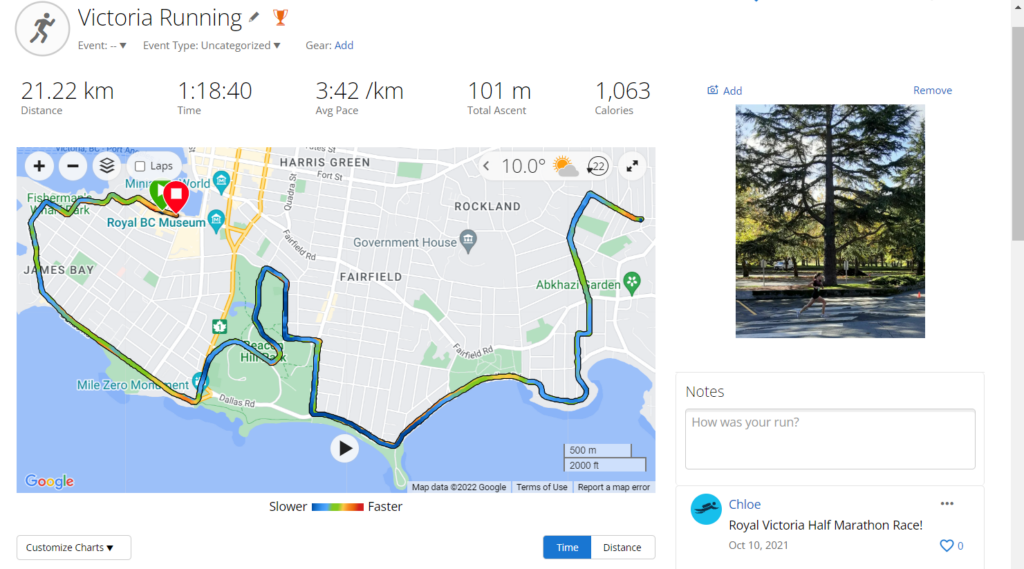
Garmin connect activity data from race

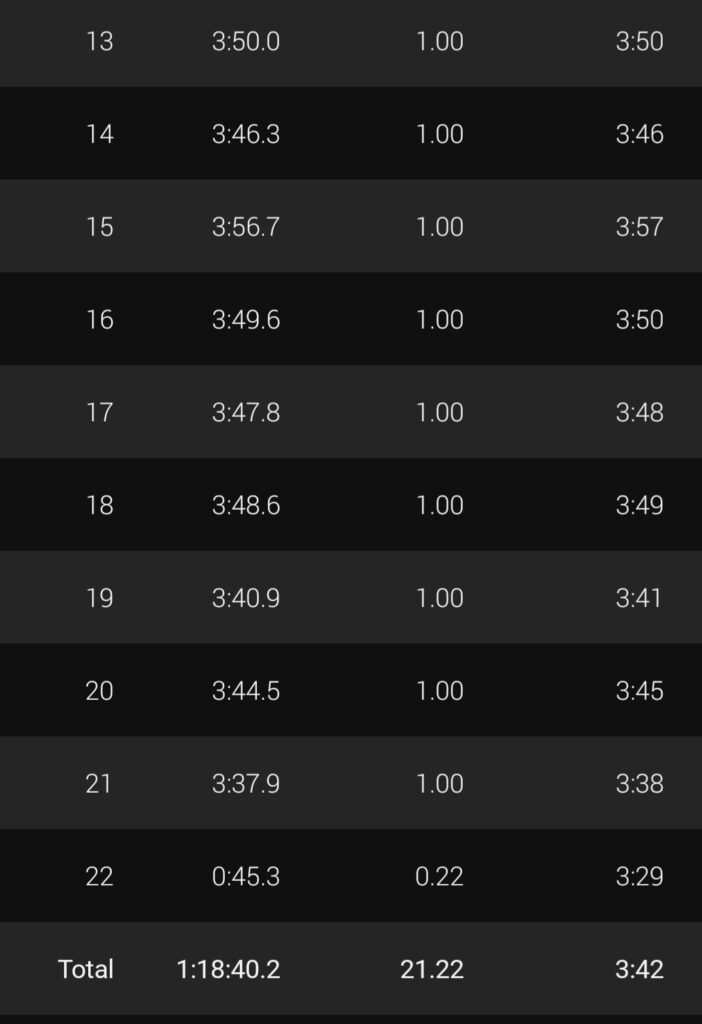
I started the race strong. It was an out-and-back course, and the way out was definitely assisted by a tail wind. This made my pace slightly quicker than planned (probably about 5-6 seconds/kilometer). Combined with the fact that I had extra nervous energy from not racing in a long time, I don’t think the faster pace negatively impacted my energy levels for the second half of the race. By the time we turned around at the 10.55 km point, I was feeling good still and maintaining a 3:40-45/km rhythm. However, right around the 14km point, the head wind was brutal! I slowed to a 3:57/km split, and my effort level definitely crossed the aerobic threshold! The last 5km I was determined to recover from the tough headwind and finish strong. There were a few people within about 5-15 seconds ahead of me during this stage of the race that gave me extra drive to keep my pace consistent and pass them ahead of the finish (which I did!) I was really happy to finish as the 3rd female overall with a time of 1:18:40!

1 km Splits from the first 12 km of the race
1 km Splits from the final 9 km of the race

Overall, I’m really happy with the race I ran and the training I did to make me feel so prepared and able to race to my fitness level. I’m so excited for my next opportunity to race a half-marathon, and for the training that it’ll take to get into PB shape! I hope to run the half-marathon in Victoria again. It is a great event and I highly recommend checking their website https://www.runvictoriamarathon.com/ if you are interested in learning more about/participating in this great community event!

What I Eat In A Day To Fuel My Training Runs

For this blog, I used https://www.canva.com/ to outline what I eat during a typical training day! Please note: when I describe what I eat during a day, I don’t focus on actual amounts or calorie counts. This is because I eat as much as I feel I need to recover from one training session and fuel for the next one. I don’t want to limit my food intake if I’m extra tired or if my training session is more physically demanding than anticipated.

Below is the link to my “canva” food diary!

https://www.canva.com/design/DAFRtUSRAcs/ognsBL1e1CglkbFe3zwdFA/watch?utm_content=DAFRtUSRAcs&utm_campaign=designshare&utm_medium=link2&utm_source=sharebutton

Songs to Sing When I’m Lonely on My Runs!

Aside from running, listening to music is my favorite activity. I love music, I love learning about musicians, I love reading about the creative processes of my favorite musicians, and I love to listen to music all day, every day! When people find out that I am a runner, they often ask me what kind of music I listen to when I run. Technically, running is the one activity I complete without listening to music. When I study – I listen to music. When I cook, I listen to music. When I walk, I listen to music. When I’m at work, I’m listening to music. But when I run, I’m disconnected from my technology devices. I focus on my rhythm, my running form, my breathing, how I feel, the scenery, and my thoughts. That is not to say, however, that I don’t sing songs in my head while I run. Really, I am never truly disconnected from the music I love! Sometimes when I run, I am so in tune with the music that plays in my head that I lose track of time!

Below is a playlist of some of the songs of artists that I often listen to; these are among the songs that I sing to myself (in my head) when I run!

https://youtube.com/playlist?list=PLFqkLSkjdNqkGLnN2SCBhXC2Ot7MIJDXX

Screenshot taken on my YouTube Running Playlist. Does this not look like a beautiful location for running?!

There are many reasons why I choose not to listen to music while I am running. For one, I like to run on the roads! Although I run on quiet roads without a lot of traffic, I like to be in tune with the potential safety hazards around me. Additionally, I don’t like to carry my phone with me on my runs. I like to run with free hands, and take advantage of the period of time where I am solely focusing on myself when I’m out accumulating miles. However, if you are the type of runner that likes running with music and needs to listen to music to get through your runs, I hope you enjoy my “mental” running playlist and find it motivates you to get through your runs successfully!

BC EdAccess

This week in class, we had Chantelle Morvay-Adams of BC EdAccess join our session. This was an incredibly valuable presentation and I felt like we learned a lot of important information about BC EdAccess as well as how to create an inclusive, accessible for all, classroom environment. Below is a video from https://bcedaccess.com/ which describes who they are and their initiative to create equitable learning opportunities for all students throughout BC classrooms:

I’m very grateful that Chantelle spoke with us and described the impactful work that occurs at BC EdAccess to advocate for equitable access to education for students with disabilities, and provide support for their families. Not only were we introduced to this incredible resource and organization, but it gave me the opportunity to reflect on my experience as a student, what I observed which may not have been supportive of all learners in the classrooms, and what I can do as a teacher to create an inclusive, comfortable learning environment which will best support all students in their educational journeys.

We discussed ways in which students are being excluded from class-activities and as a result losing valuable opportunities for learning when their teachers do not fully consider the needs of all students. For example, some students are being excluded from field trips and certain activities due to the absence of accessibility to support their participation. With this in mind, we discussed in small groups the actions and considerations that we should make as educators to ensure equitable access to learning and education for all. Some of the topics discussed by my group:

  1. Technology for accessibility: give access to technology which will support students during their learning and may be the difference between being able to participate in a classroom activity or not!
  2. My group discussed that technology for accessibility should be available as an option for all students to create an inclusive learning environment and break systemic barriers in the classroom. Not only will this provide students with another tool to support their learning/expose them to new technology to support learning in an alternative way, it will make everyone feel included and as though these technologies are not only for accessibility, but also awesome resources to support learning in general.

Balance Board Exercises and Band Exercises to Supplement your Training!

Balance, Stability, Mobility, Durability…. these are some of the words that come to my mind when I think of being the type of runner that is able to sustain their training volume. Running is a physically taxing activity- so there is the potential for injury and illness when you train day after day after day. There are so many elements which are essential to your sustainability and health as a runner; recovery and nutrition (an entire post will be dedicated to this piece!), strength, and an ability to physically withstand the demands of constant pounding on the ground! In this post, I will go over some of the supplementary training exercises I complete to benefit my training. Especially as a student, sitting down several hours a day completing assignments, it is important to make sure my body is prepared to meet the demands of run training. Below are some video demonstrations of what I like to do before my runs to ensure I’m ready to go!

1. Balance Board Exercises!

The Balance Board is an awesome tool to use for a few minutes before each run. I like to do a few variations with various levels of difficulty to warm up:

  1. Two feet flat on board – the most basic of exercises to warm up for the rest!
  2. One foot slightly ahead of the other (feet flat on board) – mimics the running movement – there is always one foot in front of the other when you run, so it makes sense to warm up with this balance skill!
  3. On the balls of your feet – this one makes it more of an advanced balance exercise and also focuses on ankle stability which is really important for trail running and cross-country running!
  4. Single legged – when you run, you are constantly performing several single legged movements; it makes sense to warm up with this in mind to get yo ready to run and make your single-legged balance strong!
  5. Band exercises on the balance board – a good exercise which incorporates balance, mobility and resistance training. I like to save this one for last since it is the most difficult of them all!

2. Band Exercises!

Bands are a great tool to use to increase the difficulty level of the exercises by providing more resistance! This exercise can be completed without a band as well; once you are comfortable with the movement and have the balance to complete it, you can incorporate the band to make the exercise more challenging! For this exercise, the goal is to stay up on the balls of your feet (as you would while you run) and practice the movements while keeping your feet pointing forward (as you would while you run). It is a good way to practice form efficiency and forward movement and translate this skill into your running!

I hope you find these videos helpful and find some benefit in performing these activities to supplement your run training!

The Online Learning Environment

In class, we discussed the online learning environment: its benefits and its setbacks, synchronous versus asynchronous activities, and the various resources/platforms that are currently available for learning online. Below are my thoughts on a couple of online learning platforms through which I have found success as a student:

Brightspace

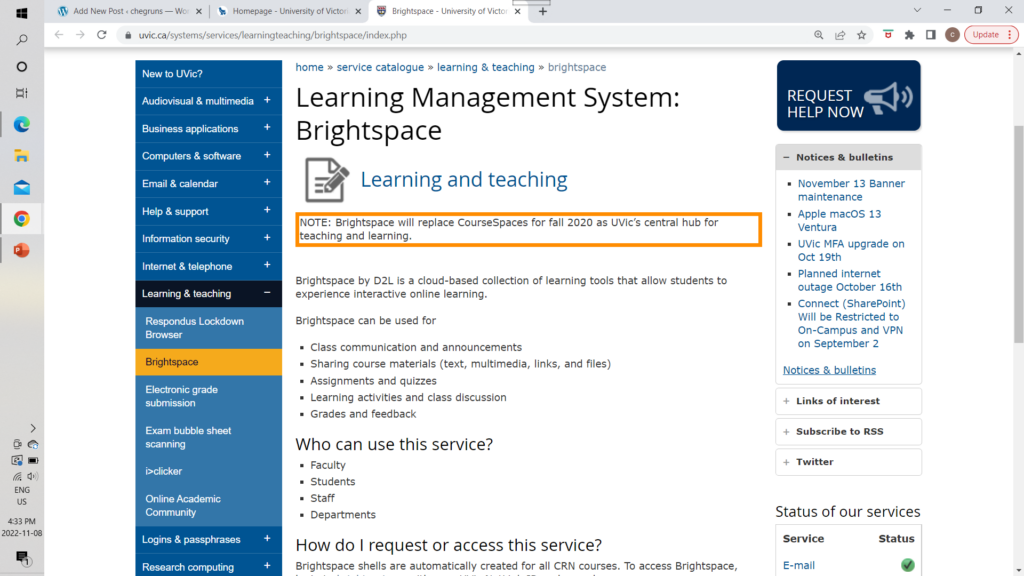
Brightspace – Screenshot of:
https://www.uvic.ca/systems/services/learningteaching/brightspace/index.php

Brightspace is a great online learning platform for teachers to upload resources for students to access online. As a student, I have used Brightspace for a couple of semesters of University coursework, and I have loved it! The first semester that I used Brightspace was when all learning was taking place online, as a result of the pandemic. Despite the challenges of jumping into an online learning environment, I felt like Brightspace made for a great alternative to in-person, completely synchronous learning. I appreciate having access to an online space for education where everything is together: resources for students, assignment drop boxes, etc.; I think it helps to make an organized learning environment! There are a few features to Brightspace that I enjoy using to make the learning feel more student-centered. For example, there is a space for class discussion in which students can share their ideas and engage in learning with each other and discussing the course content. Additionally, it is an easy platform through which to communicate with your instructor and classmates with the instant messages and email features.

Zoom

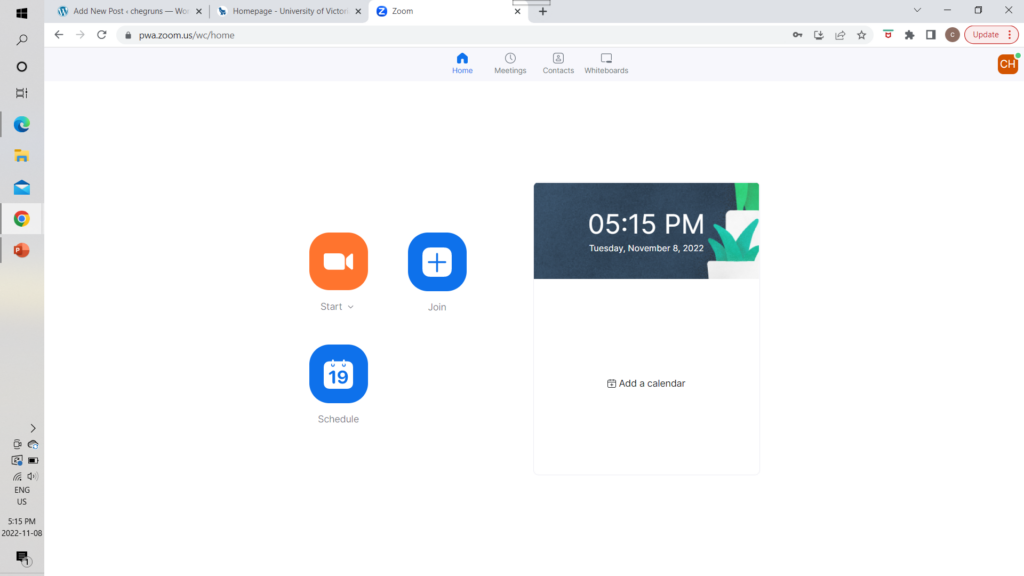
Zoom – Screenshot of: https://pwa.zoom.us/wc/

Zoom is an awesome way for online learning to occur in a synchronously. In most Zoom classes I’ve attended, the teacher is the host that is conducting the lecture to the students (the guests). Zoom is a great way to have everyone learning at the same time in the same virtual space; to that extent, it may increase accessibility for learning. As a student, I like how Zoom allows for continued learning when I am sick or unable to attend class. During the height of the pandemic, it was great to be able to simply log into Zoom from the comforts of my home environment and participate in class without the stress of getting sick or potentially making other students sick. I also appreciate the ability to avoid the commute and study from home synchronously; with the climate crisis, I want to be able to do what I can to minimize my carbon footprint, and not having to waste gas and release pollution into the air during a commute to school is a big plus for me! The only thing I don’t like about Zoom is that it feels a bit awkward and it can be intimidating to participate actively in an online lecture. However, the more Zoom sessions I attend, the easier it becomes!

Overall, I think that online learning is a great option and I think that as technology advances and our world evolves, the online learning environment becomes more effective and suitable for students. Currently, I appreciate a mixture of online and in-person learning opportunities, and as discussed in class, a mixture of synchronous and asynchronous activities. I think that as long as there is a good balance between teacher centered and student centered activities, and access is equitable, online learning is a viable approach to helping students learn, grow, and succeed in their educational journeys!

Winter Running Essentials!

It is getting cold outside, which means out are days of running with shorts and a t-shirt, and a warm welcome to cold runs with long sleeves, gloves, tights, and toques! Running in the fall and winter requires a bit more preparation to ensure you are comfortable, prepared, and have a plan to warm up immediately post run! Here is a compilation of my winter run must haves/must dos in order to enjoy running through the cruelest months of the year!

I must check the weather network hourly forecast before my winter runs. Especially on days where I don’t have many commitments and I have the freedom to chose when I would like to go for my run outside, looking at the hourly forecast is a great way to plan your run to occur during the time when the conditions are most ideal! I also like to check the hourly forecast on days when I need to run at a specific time; that way, I can dress for the weather and be as prepared for an enjoyable run as possible. Below is the link for the hourly forecast:

https://www.theweathernetwork.com/ca/hourly-weather-forecast/british-columbia/victoria

Running location / running attire:

I hope this blog of winter running recommendations was helpful! Running in wintery conditions isn’t always ideal, but I think the extra planning/preparation time required to ensure you can enjoy your runs is so worth it! Also, even if the weather isn’t nice, I always feel better after a run; I will do what I can to ensure I am able to run year-round to improve my mood and well-being!

Multimedia Learning Theory and Image Editing

Figure 1: Aussie Shepherds in their element!

Imagine I was speaking to a group of students, or reading them a PowerPoint slide with nothing but text on it that said something like this:

“Picture a scene in a rural environment. It is an autumn day, and although the sky is full of grey clouds, it looks like the sun is trying to break through. In the background, there are colorful deciduous trees which border a field. In the field, there are two Australian Shepherds: one Black Tri Aussie Shepherd, and one Blue Merle Aussie Shepherd. There is a small herd of sheep behind them; the Aussies are truly in their element!”

Without a visual, it could possibly be difficult for some students to “picture” what is going on in the above description. What if they don’t know what an Australian Shepherd is? What if they don’t know what a deciduous tree is? There are some terms in the description which would require some prior knowledge (type of tree, breed of dog, etc.) for the students to fully understand it. An image to describe the scene would be beneficial to support the students that may not have the prior/specific knowledge! Not only would a visual aid be able to help students better understand the description, it may help them form definitions/descriptions for the terms they don’t know. In other words, the visual alongside the text increases the students learning/understanding of the description. This theory ties into the Multimedia Learning Hypothesis that a combination of text and images promotes deeper learning of a concept.

In class today, we discussed this concept of using text and images to better support students’ learning. For the most part, I agree with the statement. When I am new to a topic, I appreciate a mixture of visuals and text to increase my learning. For example, in a unit which introduces new vocabulary in a second language course, I benefit from visuals to help me define words without needing to translate them to English. I always find my understanding of a second language is best when I am able to understand the text visually in my mind rather than needing to first translate it in my mind in order to achieve a visual understanding of the text. However, once I am more familiar with something, or competent in a certain subject area, I personally don’t feel the need to have images to support my understanding of a written text because my deeper comprehension of a certain concept implies that I can visualize its meaning/significance in my mind. Hence, in my experience, I agree with the Multimedia Learning Hypothesis for the early stages of learning, but I don’t think it is absolutely necessary to represent content in a multimodal manner once I’ve achieved a certain level of understanding on a specific topic.

The image in Figure 1 represents the scene I described with the Australian Shepherds and sheep in the field lined by deciduous trees. I created this image using other images with PowerPoint. I never knew that PowerPoint was such a useful resource – it was so simple to create this image, and I am excited that I learned about the various uses of PowerPoint so that I can easily make my future lessons/presentations more multimodal!

« Older posts

© 2026 chegruns

Theme by Anders NorenUp ↑