A space for reflection

Category: Free Inquiry

This is the category to apply to your Free Inquiry posts.

2021 Royal Victoria Half Marathon: A Recap Of The Best Race I’ve Ever Run!

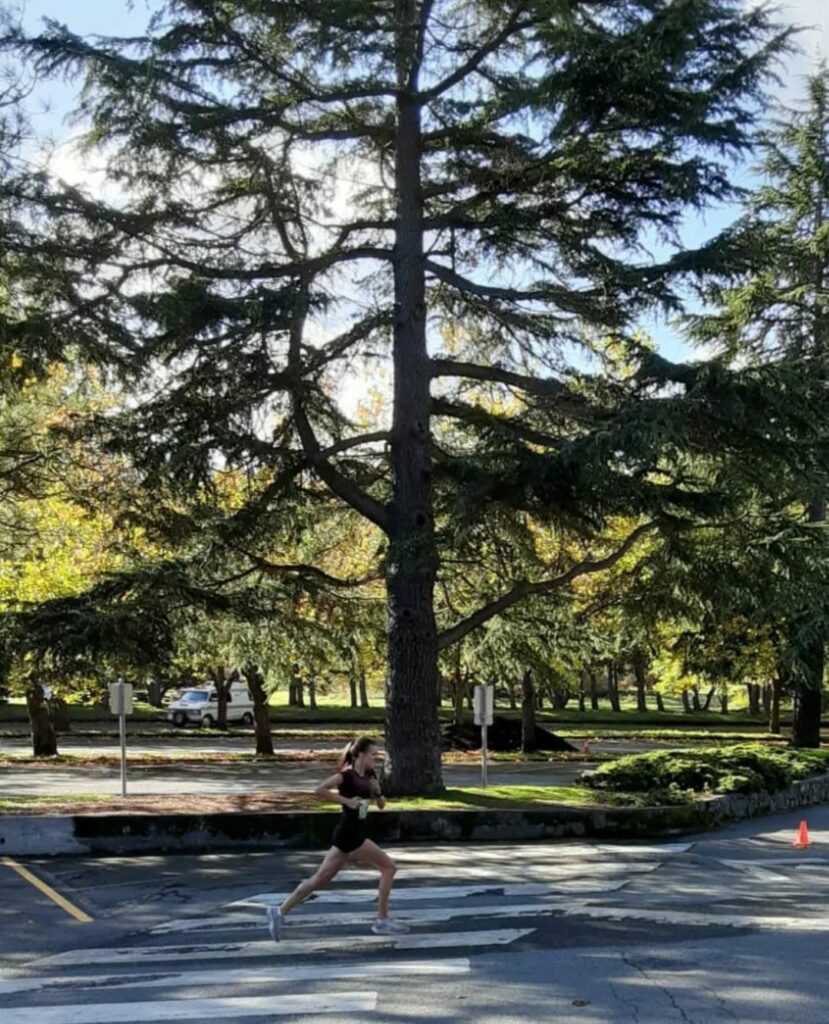
Working hard in the last ~5km of the race

On Thanksgiving Weekend in 2021, I participated in the Royal Victoria Half Marathon. I was very excited for this race for a number of reasons:

  1. It was going to be my first race since the start of the pandemic (nearly 2 years away from racing!) Racing isn’t my favorite thing about being a runner, but when races come but once every couple of years, they are pretty exciting!
  2. I had trained very specifically and consistently for the half-marathon for a full year leading up to it. Tempo runs, long runs, progression runs, and hill runs were a major part of my training in 2020/2021, so I felt pretty in tune with the rhythm/effort of half-marathon pace.
  3. As a result of my extended preparation for the race, I felt very confident in my fitness and in my ability to perform to my potential. It was a great feeling to go into a race feeling nerves as a result of wanting to showcase your hard-work and preparation rather than feeling nerves from a lack of confidence in your training and your ability. I hadn’t experienced this feeling heading into a race in a very long time, so it was quite refreshing!
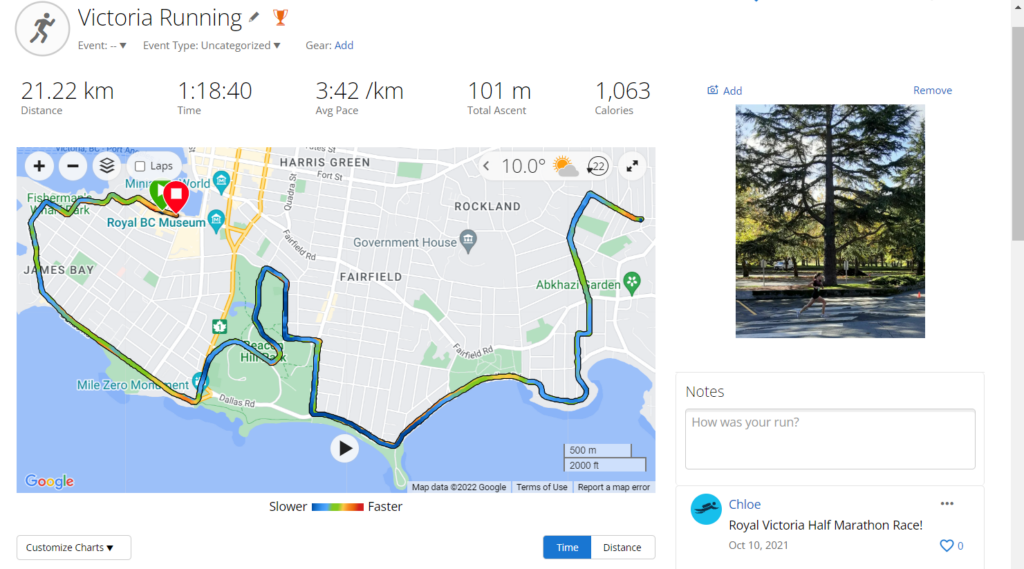
Garmin connect activity data from race

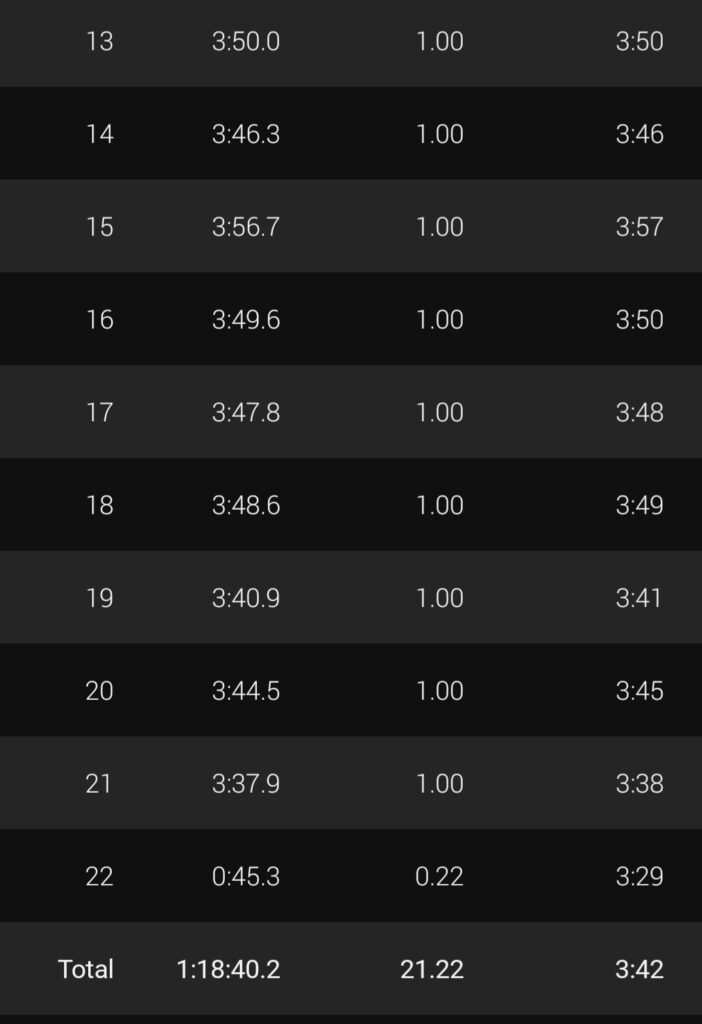
I started the race strong. It was an out-and-back course, and the way out was definitely assisted by a tail wind. This made my pace slightly quicker than planned (probably about 5-6 seconds/kilometer). Combined with the fact that I had extra nervous energy from not racing in a long time, I don’t think the faster pace negatively impacted my energy levels for the second half of the race. By the time we turned around at the 10.55 km point, I was feeling good still and maintaining a 3:40-45/km rhythm. However, right around the 14km point, the head wind was brutal! I slowed to a 3:57/km split, and my effort level definitely crossed the aerobic threshold! The last 5km I was determined to recover from the tough headwind and finish strong. There were a few people within about 5-15 seconds ahead of me during this stage of the race that gave me extra drive to keep my pace consistent and pass them ahead of the finish (which I did!) I was really happy to finish as the 3rd female overall with a time of 1:18:40!
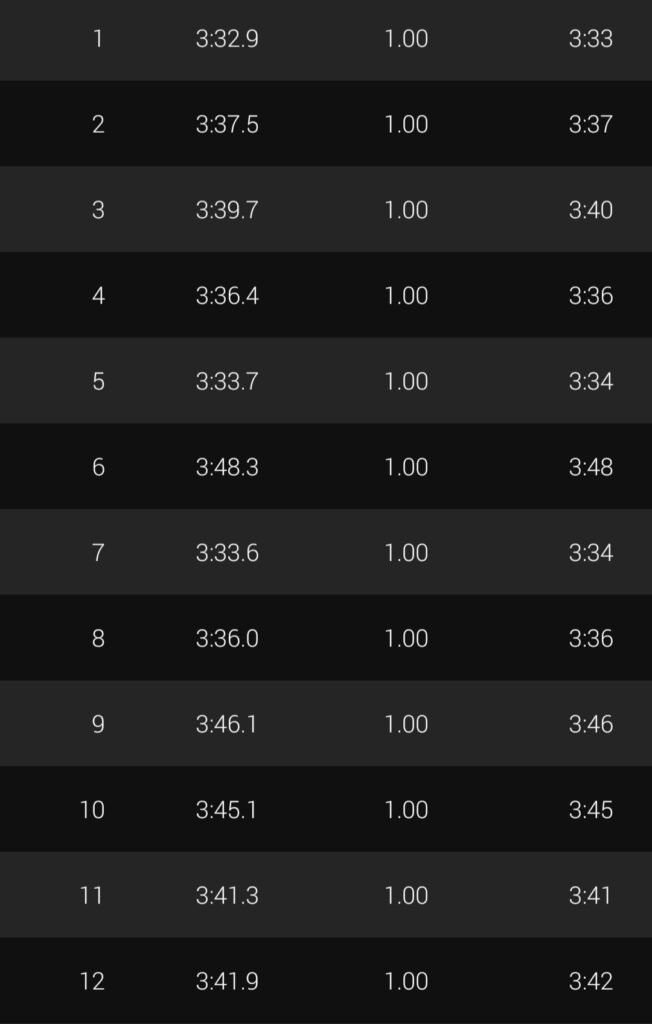
1 km Splits from the first 12 km of the race
1 km Splits from the final 9 km of the race

Overall, I’m really happy with the race I ran and the training I did to make me feel so prepared and able to race to my fitness level. I’m so excited for my next opportunity to race a half-marathon, and for the training that it’ll take to get into PB shape! I hope to run the half-marathon in Victoria again. It is a great event and I highly recommend checking their website https://www.runvictoriamarathon.com/ if you are interested in learning more about/participating in this great community event!
What I Eat In A Day To Fuel My Training Runs

For this blog, I used https://www.canva.com/ to outline what I eat during a typical training day! Please note: when I describe what I eat during a day, I don’t focus on actual amounts or calorie counts. This is because I eat as much as I feel I need to recover from one training session and fuel for the next one. I don’t want to limit my food intake if I’m extra tired or if my training session is more physically demanding than anticipated.

Below is the link to my “canva” food diary!

https://www.canva.com/design/DAFRtUSRAcs/ognsBL1e1CglkbFe3zwdFA/watch?utm_content=DAFRtUSRAcs&utm_campaign=designshare&utm_medium=link2&utm_source=sharebutton

Songs to Sing When I’m Lonely on My Runs!

Aside from running, listening to music is my favorite activity. I love music, I love learning about musicians, I love reading about the creative processes of my favorite musicians, and I love to listen to music all day, every day! When people find out that I am a runner, they often ask me what kind of music I listen to when I run. Technically, running is the one activity I complete without listening to music. When I study – I listen to music. When I cook, I listen to music. When I walk, I listen to music. When I’m at work, I’m listening to music. But when I run, I’m disconnected from my technology devices. I focus on my rhythm, my running form, my breathing, how I feel, the scenery, and my thoughts. That is not to say, however, that I don’t sing songs in my head while I run. Really, I am never truly disconnected from the music I love! Sometimes when I run, I am so in tune with the music that plays in my head that I lose track of time!

Below is a playlist of some of the songs of artists that I often listen to; these are among the songs that I sing to myself (in my head) when I run!

https://youtube.com/playlist?list=PLFqkLSkjdNqkGLnN2SCBhXC2Ot7MIJDXX

Screenshot taken on my YouTube Running Playlist. Does this not look like a beautiful location for running?!

There are many reasons why I choose not to listen to music while I am running. For one, I like to run on the roads! Although I run on quiet roads without a lot of traffic, I like to be in tune with the potential safety hazards around me. Additionally, I don’t like to carry my phone with me on my runs. I like to run with free hands, and take advantage of the period of time where I am solely focusing on myself when I’m out accumulating miles. However, if you are the type of runner that likes running with music and needs to listen to music to get through your runs, I hope you enjoy my “mental” running playlist and find it motivates you to get through your runs successfully!

Balance Board Exercises and Band Exercises to Supplement your Training!

Balance, Stability, Mobility, Durability…. these are some of the words that come to my mind when I think of being the type of runner that is able to sustain their training volume. Running is a physically taxing activity- so there is the potential for injury and illness when you train day after day after day. There are so many elements which are essential to your sustainability and health as a runner; recovery and nutrition (an entire post will be dedicated to this piece!), strength, and an ability to physically withstand the demands of constant pounding on the ground! In this post, I will go over some of the supplementary training exercises I complete to benefit my training. Especially as a student, sitting down several hours a day completing assignments, it is important to make sure my body is prepared to meet the demands of run training. Below are some video demonstrations of what I like to do before my runs to ensure I’m ready to go!

1. Balance Board Exercises!

The Balance Board is an awesome tool to use for a few minutes before each run. I like to do a few variations with various levels of difficulty to warm up:

  1. Two feet flat on board – the most basic of exercises to warm up for the rest!
  2. One foot slightly ahead of the other (feet flat on board) – mimics the running movement – there is always one foot in front of the other when you run, so it makes sense to warm up with this balance skill!
  3. On the balls of your feet – this one makes it more of an advanced balance exercise and also focuses on ankle stability which is really important for trail running and cross-country running!
  4. Single legged – when you run, you are constantly performing several single legged movements; it makes sense to warm up with this in mind to get yo ready to run and make your single-legged balance strong!
  5. Band exercises on the balance board – a good exercise which incorporates balance, mobility and resistance training. I like to save this one for last since it is the most difficult of them all!

2. Band Exercises!

Bands are a great tool to use to increase the difficulty level of the exercises by providing more resistance! This exercise can be completed without a band as well; once you are comfortable with the movement and have the balance to complete it, you can incorporate the band to make the exercise more challenging! For this exercise, the goal is to stay up on the balls of your feet (as you would while you run) and practice the movements while keeping your feet pointing forward (as you would while you run). It is a good way to practice form efficiency and forward movement and translate this skill into your running!

I hope you find these videos helpful and find some benefit in performing these activities to supplement your run training!

Winter Running Essentials!

It is getting cold outside, which means out are days of running with shorts and a t-shirt, and a warm welcome to cold runs with long sleeves, gloves, tights, and toques! Running in the fall and winter requires a bit more preparation to ensure you are comfortable, prepared, and have a plan to warm up immediately post run! Here is a compilation of my winter run must haves/must dos in order to enjoy running through the cruelest months of the year!

I must check the weather network hourly forecast before my winter runs. Especially on days where I don’t have many commitments and I have the freedom to chose when I would like to go for my run outside, looking at the hourly forecast is a great way to plan your run to occur during the time when the conditions are most ideal! I also like to check the hourly forecast on days when I need to run at a specific time; that way, I can dress for the weather and be as prepared for an enjoyable run as possible. Below is the link for the hourly forecast:

https://www.theweathernetwork.com/ca/hourly-weather-forecast/british-columbia/victoria

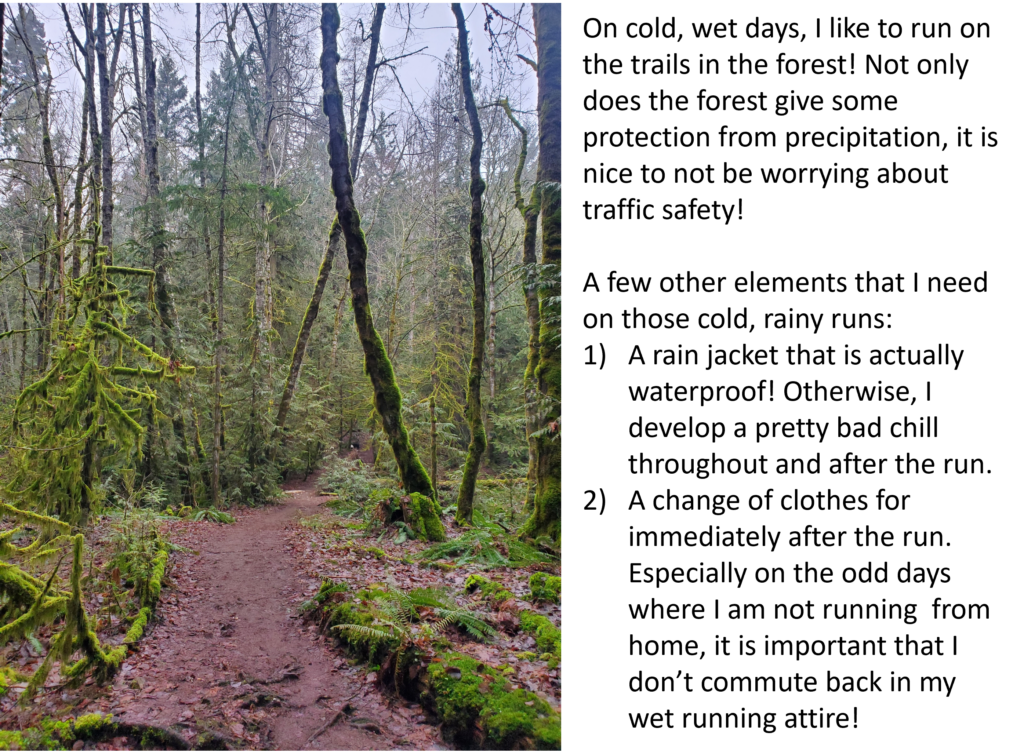
Running location / running attire:

I hope this blog of winter running recommendations was helpful! Running in wintery conditions isn’t always ideal, but I think the extra planning/preparation time required to ensure you can enjoy your runs is so worth it! Also, even if the weather isn’t nice, I always feel better after a run; I will do what I can to ensure I am able to run year-round to improve my mood and well-being!

An Awesome Resource to Map Out Your Runs!

Below is a video I made of an awesome resource that I love to use to map out my runs! The website is called http://onthegomap.com. It’s a great tool that helps you to plan your run routes in advance. As a runner, I like to have an idea of where I’m running, roughly how long the run will be and how hilly it will be before I head out onto the roads and trails. Not only does this website help you plan your run routes, it is a great way to discover new trails! How many times have you been on a run and you don’t want to go to the end of an unknown road out of fear that there won’t be a connector trail? With tools like this interactive running map, you can learn about the road and trail systems in your area to help you explore on your runs! I hope you find this tool as useful as I do; many of my favorite go-to loops were planned as “adventure runs” using this fantastic resource!

How to navigate onthegomap.com

Running in Beautiful Places!

Running on Country Roads is my favorite activity!

Something that makes running so enjoyable for me is being able to explore new routes and discover beautiful rural roads and trails. Whenever I go camping or exploring, it is a priority for me to go out for a run, get to know the area, and find new beautiful places to enjoy movement! This video is from last summer when I was exploring the gulf islands. Earlier that day, I had already went for a 1 hour and 50 minute run before hopping on the ferry boat, so I was physically a bit tired. However, when my family and I went to some beach accesses off this road, I needed to run on it – the ocean views (not in video), the tree lined streets, and the quietness were all so inviting to an avid runner!

When trying a new route, I do like to have a general idea of where I am going, the distance of my planned loop, and the elevation profile. That sounds pretty specific, but thankfully there are many great running map specific websites out there that are really helpful. My favorite one to use is https://onthegomap.com/#/create

I think that choosing cool routes and going on exploration runs is a great way to add excitement and fun to your training week. Switching up your run routes will keep things new and engaging, and it may be the source of motivation you need to start a run on a day when you just need that extra incentive to get out the door!

Garmin Connect – A form of Social Media for Runners!

As one of our Ed Tech Classes was focused on Social Media use, I thought it would be cool to share the Social Media platform that I use to document my training – Garmin Connect! Now, I say social media because there is the option to make connections and connect with your contacts so others can see your daily training and vice versa. I have turned off this setting – I love Garmin Connect for the way it allows me to log my training and see all the statistics of my runs – but I don’t want that to be public to anyone else. This is mostly because I don’t want Garmin Connect to become a space in which I feel I have to run more, or run faster in order “to impress” my Garmin Connect Contacts, and I don’t want to see what others are documenting, compare their training with my own, and become discouraged. Either of those instances lead to a negative association with this social media platform, which I think is an otherwise wonderful resource, so I just turn off that setting to avoid that altogether! I think this goes back to the idea that Social Media isn’t a horrible resource; what matters is HOW you use it.

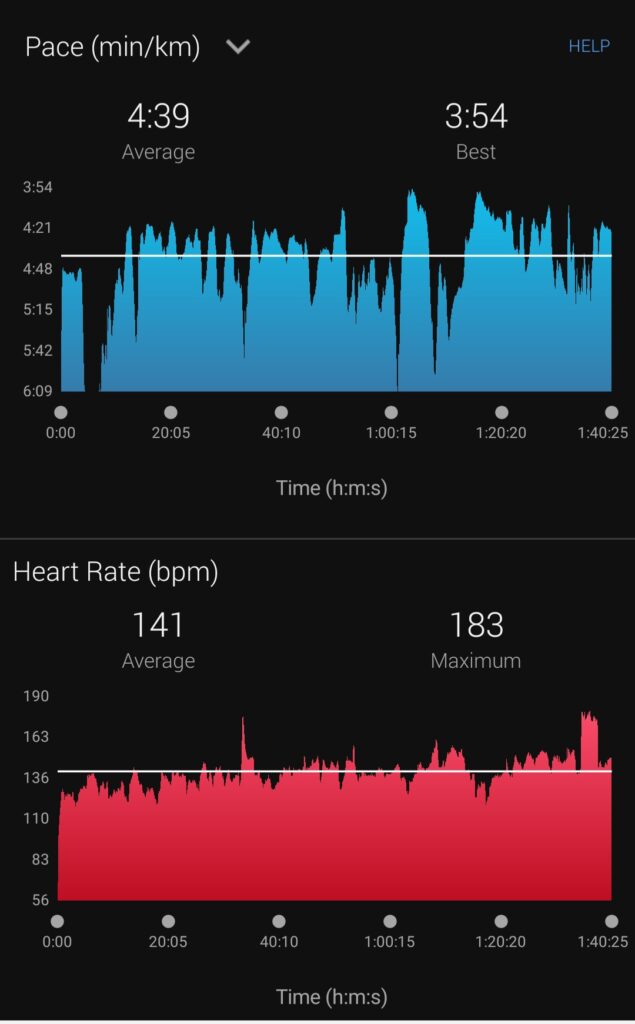
Figure 1: Pace (min/km) and Heart Rate (bpm) throughout this 1:40:25 easy run

In Figure 1, we see graphical representations of my pace (how long it takes me to run a kilometer in minutes) and my heart rate (in beats per minute) throughout a ~100 minute run I completed a couple of weeks ago. As you can see from the graph, my pace fluctuates quite a bit throughout the run! This is mostly because the runs I do are very hilly (I slow down uphill, speed up on the flats and downhills), they are in and out of smooth roads and twisty, technical trails, and overall, I start my runs a bit slower than I finish them. In the second graph of the above image, we see the fluctuation of my heart rate throughout my run. Overall, it doesn’t change too much (a bit lower at the start than the end, which is to be expected), with the exception of a few “spikes” which are probably a result of the increased effort it took to run up some of the hills on this run! That being said, I often find the heart rate monitor is very inaccurate – likely due to the fact that it is built into my wristwatch – so for the most part, I ignore this information.

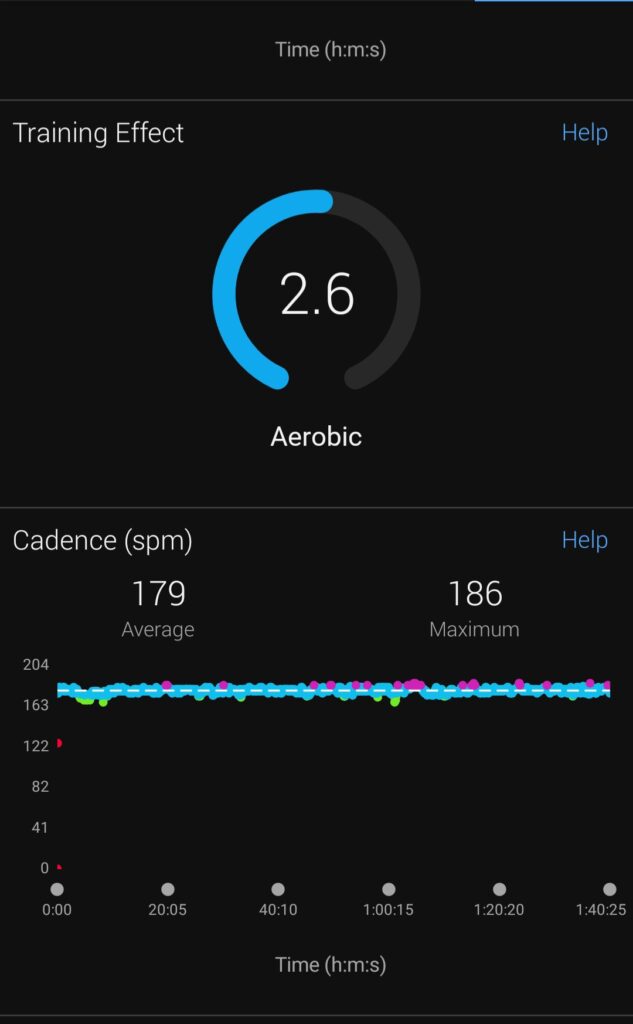
Figure 2: Training Effect (numeric score based on training zone), and cadence (in steps per minute)

In Figure 2, we see “Training Effect” – an assigned numeric score based on the duration spent in specific training zones – this has to do with average heart rate. Both this number and the graph representing heart rate (see figure 1), are the 2 factors I typically neglect when I refer to the data on Garmin connect after a run as a result of the inaccurate heart rate monitor which influences this data. The second graph in figure 2 is the information that most interests me about my runs. Cadence is another way to say “stride frequency” or simply “number of steps per minute.” Typically, for an easy run, I want to be close to ~180 steps per minute (this run I averaged a cadence of 179 spm, so pretty good!). This is where I feel I am moving the most efficiently and ultimately reducing the risk of injury. On harder runs, my cadence is typically closer to ~185 to 190 spm.

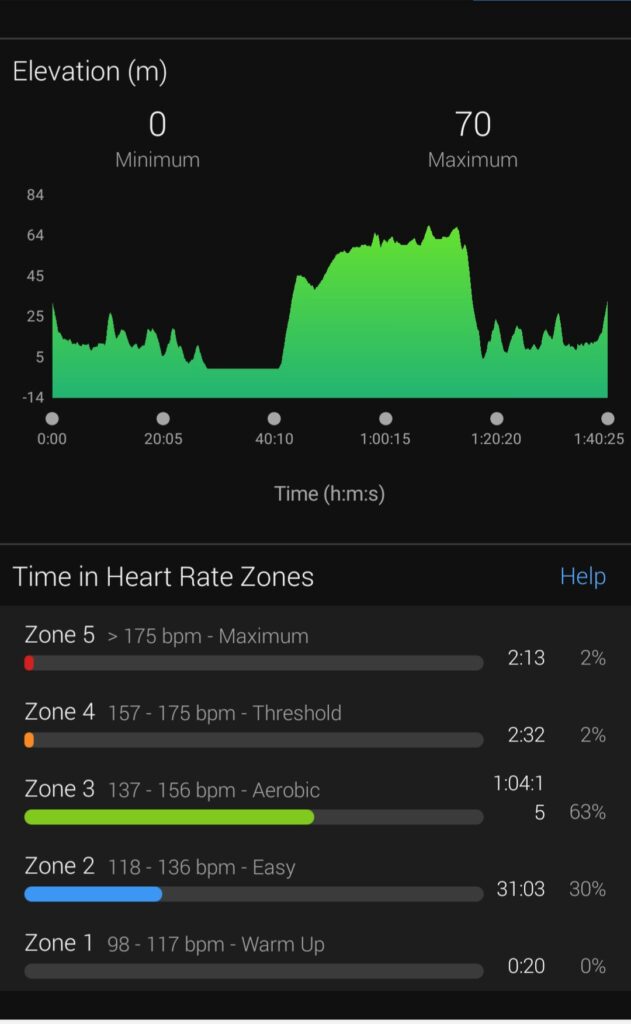
Figure 3: Elevation profile (in meters), and time spent (in minutes) in training zones

Figure 3 shows an elevation profile (altitude in meters with respect to time throughout my run) in the first graph, and time in heart rate zones in the second diagram (once again, as this information is based on data collected from an inaccurate heart rate monitor, I don’t pay too much attention to this). I really like to look at the elevation profile of my runs. I think the hillier the run, the better because it adds variety to your run, trains different groups of muscles (whether going up, or down, or flat) and it fluctuates the effort level. A “varied” run provides more physical stimulus, making it more challenging, but it also makes it harder to “overdo it” reducing the risk of injury!

Evidently, there are some data points that this platform collects which are negligible do to the inaccuracies of the heart rate monitor, for example. However, that is not to say that Garmin Connect is not an excellent tool. To me, there is a lot of valuable information that Garmin gathers during a run and I love to be able to refer to this data on my Garmin Connect in order to see patterns in my training progress. For example, I’ve realized that I feel better AND run better when my cadence is good (~180 spm for easy runs) and this is often a positive correlation with an increase in fitness, speed, and consistency! These are patterns I like to see in my training, and it is awesome to have a tool to be able to record/reflect on this data!

A typical week in training

Having a balanced training program is so important for many reasons. For one, it adds variety to your training week; it makes training sessions more fun when you aren’t doing the same thing day after day! Plus, a varied training program is a balanced training program. I think balance is the most important aspect of any training plan, especially when the training being done is very long and repetitive, such as long distance running! Not only will a balanced training program help to prevent injuries, it will help you improve, too! Exposing yourself to different physical stimuli with a variety of specific sessions is a great way to keep training exciting and get the most out of your week. In this blog entry, I will outline the various sessions I complete throughout the week which keep me motivated, happy, and improving!

Easy Runs

Easy mileage takes up about 75 – 80% of my training week – between warm up runs, cool-down runs, recovery runs, and long easy runs – every run day I’m running easy at some point! I try to define an easy run by a feeling rather than a pace. For example, if I am extra tired from school or work or a hard run, my easy pace will be slower than if I am fresh and well-rested. Easy runs are a great opportunity to explore a new run route, have a nice conversation with a friend, or just zone out and enjoy accumulating easy kilometers!

Long Runs

The long run is quite self-explanatory – it is your longest run of the week! Normally, I complete one to two long runs per week. I typically run them at an easy pace, but sometimes I incorporate faster paces for portions of my long run (see below- progression runs). The training purpose of long runs is to build up endurance and durability. I’ve raced a range of distances as short as 800 m to as long as a half marathon (21.1km), and I’ve found the long run to be an integral part of my training plan in all of those distances!

Threshold Runs

These are run at the threshold of comfort. If you are trying to define your threshold pace, it is as fast as you can run before your breathing changes over from controlled, representative of an “aerobic” effort, to labored, or entering the anaerobic zone. Another way to describe a tempo run is as the fastest run pace you could maintain for 60 minutes. However, depending on your training goals, the pace and the workout can be adapted to reflect varying distance/intensity. For example, a session such as 4 x 8 minutes hard with 2 minutes easy jog between hard reps could be run at a pace you could maintain for 30-40 minutes; you can increase the intensity of the session while remaining in the aerobic/threshold zone because the jog break gives your body the chance to recover from the harder effort. My favorite threshold workout is anywhere from 30-50 minutes continuous at a steady pace.

Progression Runs

Progression runs are one of my favorite sessions. They are typically longer runs, but the idea is to pick up the pace as the run goes on. So, by the end, you are running the fastest pace of the entire run. They are a great way to practice running fast and efficient while fatigued. Progression runs are also a great opportunity to practice pacing and patience; a great set of skills to have if you enjoy competing in longer distance races!

Long Distance Running

I have chosen to explore the topic of Long Distance Running for my Free Inquiry Project. Running has been a passion of mine since I was a young elementary school student. My journey as a runner began when I was 8 years old where I was introduced to the sport of athletics as a participant in school cross-country and track. If I reflect upon my feelings about running back then, while I definitely enjoyed it, I wouldn’t have imagined that it would grow to become such an influential part of my life today.

Running is a big part of my identity and within my mind I can easily make a connection between my running and everything else I do in my life. For example, I love math, physics, and statistics, and during/after my runs I love to consider the more data based/analytical aspects of my runs, such as pace and run cadence, and compare the statistics with my other runs. My run time is also when I consider reflective themes, and hence a lot of my creative thinking for my other passions, such as listening to music, writing and learning foreign languages, occurs during the tens of minutes I spend running each day. I think of my week in terms of my different training runs each day, and it is the driving force that motivates me to get through challenging weeks, such as when the schoolwork load is high.

While running is my passion and the source of greatest joy and fulfillment in my daily life, I recognize that running is not for everyone. It is an acquired taste activity, and it takes determination, dedication, motivation, and commitment to discover the joy and the satisfaction that a consistent running routine can provide. My free inquiry project will outline the elements that inspire and motivate me to run everyday, from variety in training to mindset, and I hope to encourage others to find joy in running through my blog posts!

© 2026 chegruns

Theme by Anders NorenUp ↑