Cellphone use in the classroom is a difficult topic to address. I think there is a time and place for the use of mobile devices in the classroom. However, it is important that they are used appropriately and not in such a way that they are interfering with a student’s performance and concentration during instructional periods. If the student is using it in a productive way to support their education, it can be a great tool. For example, in a language classroom, an online resource such as http://wordreference.com is really useful as it can allow students to look up words efficiently without needing to use a dictionary, giving students more time to focus on their learning. Similarly, having an account on http://www.duolingo.com is a great way for students to practice their language skills during work blocks, quiet time, or when they have finished their in class activities and want to continue learning. In the math/physics classroom, having access to a calculator on a cellphone is really convenient, as is being able to look up theorems through online resources to help with a student’s understanding of the concepts/enrich their learning. All of these resources can be easily accessed with a cellphone; I know that when I was a student, I benefited from using my phone during class time to access these programs!
I think that cellphone use can become a problem when students are distracted by the social aspect of it. Social media and text-messaging can become problematic in the classroom when they take away from the students’ focus. While I am sure social media can be used in an educative way, it may also be distracting and have a negative impact on a student’s learning. I think the key note here, as discussed during one of our tech ed classes, is that social media is not necessarily bad; what matters is how we chose to use it!
Below is a video I made of an awesome resource that I love to use to map out my runs! The website is called http://onthegomap.com. It’s a great tool that helps you to plan your run routes in advance. As a runner, I like to have an idea of where I’m running, roughly how long the run will be and how hilly it will be before I head out onto the roads and trails. Not only does this website help you plan your run routes, it is a great way to discover new trails! How many times have you been on a run and you don’t want to go to the end of an unknown road out of fear that there won’t be a connector trail? With tools like this interactive running map, you can learn about the road and trail systems in your area to help you explore on your runs! I hope you find this tool as useful as I do; many of my favorite go-to loops were planned as “adventure runs” using this fantastic resource!
In class, we learned about EdCamps and we had the opportunity to participate in one ourselves. Here is a video that explains how they work and how to get the most out of your participation at an EdCamp:
EdCamps are a great opportunity for educators to come together and share their ideas about learning topics in an unformal setting. In my group’s EdCamp, our topic was on incorporating LGBTQ+ and BIPOC topics and literature in the classroom. It was a great way to learn from each-other, share our ideas, and be introduced to new valuable resources that can be used in the classroom!
I’m happy we were given the opportunity to participate in an EdCamp; I can see their value! As a future teacher of Math and Spanish, I could definitely see myself benefiting from frequent participation in this unformal type of professional development. A few topics I would love to see being explored and discussed in an EdCamp:
Cultivating a growth mindset for students in math class
Activities to encourage students to SPEAK Spanish in the language classroom
How to integrate Inquiry Based Learning in the Math and Spanish Classrooms!
Something that makes running so enjoyable for me is being able to explore new routes and discover beautiful rural roads and trails. Whenever I go camping or exploring, it is a priority for me to go out for a run, get to know the area, and find new beautiful places to enjoy movement! This video is from last summer when I was exploring the gulf islands. Earlier that day, I had already went for a 1 hour and 50 minute run before hopping on the ferry boat, so I was physically a bit tired. However, when my family and I went to some beach accesses off this road, I needed to run on it – the ocean views (not in video), the tree lined streets, and the quietness were all so inviting to an avid runner!
When trying a new route, I do like to have a general idea of where I am going, the distance of my planned loop, and the elevation profile. That sounds pretty specific, but thankfully there are many great running map specific websites out there that are really helpful. My favorite one to use is https://onthegomap.com/#/create
I think that choosing cool routes and going on exploration runs is a great way to add excitement and fun to your training week. Switching up your run routes will keep things new and engaging, and it may be the source of motivation you need to start a run on a day when you just need that extra incentive to get out the door!
Here is a video of my first time using ScreenCastify. I made this video during our EdTech class time, so I chose to turn off my microphone so there wouldn’t be any background noise in the video. In a quieter setting when using audio would be beneficial, it is evident that ScreenCastify could be used to create awesome multimodal videos for the classroom!
In this video, I just filmed my screen as I navigated the BC math curriculum page. I wanted to demonstrate how easy it is to use something like ScreenCastify. I can tell that it is a valuable resource, and could be used really well in an online learning environment. Evidently, it is a convenient tool as it allows the user to focus on their work on their computer as the filming takes place simultaneously in the background, without the user relying on a secondary technology device, such as a cell-phone, to capture the work they are doing. I think it could be a great way to offer short videos for things like lessons on computer-science, graphing, or for showing students ways to navigate the web for reputable resources for research projects for example. The opportunities are endless! Additionally, it is easy to use: I love finding resources that are user-friendly. As a future teacher, I think that discovering well-designed technological programs will be an asset for lesson planning!
Overall, I’m happy I learned about this program and I’m pleased that I was able to see the value in its application!
As one of our Ed Tech Classes was focused on Social Media use, I thought it would be cool to share the Social Media platform that I use to document my training – Garmin Connect! Now, I say social media because there is the option to make connections and connect with your contacts so others can see your daily training and vice versa. I have turned off this setting – I love Garmin Connect for the way it allows me to log my training and see all the statistics of my runs – but I don’t want that to be public to anyone else. This is mostly because I don’t want Garmin Connect to become a space in which I feel I have to run more, or run faster in order “to impress” my Garmin Connect Contacts, and I don’t want to see what others are documenting, compare their training with my own, and become discouraged. Either of those instances lead to a negative association with this social media platform, which I think is an otherwise wonderful resource, so I just turn off that setting to avoid that altogether! I think this goes back to the idea that Social Media isn’t a horrible resource; what matters is HOW you use it.
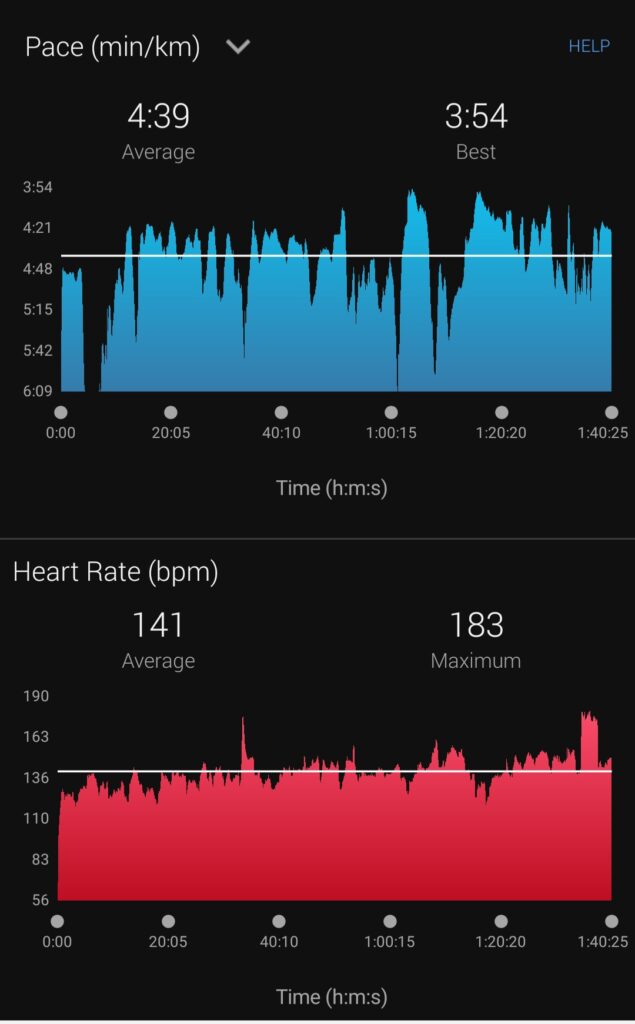
Figure 1: Pace (min/km) and Heart Rate (bpm) throughout this 1:40:25 easy run
In Figure 1, we see graphical representations of my pace (how long it takes me to run a kilometer in minutes) and my heart rate (in beats per minute) throughout a ~100 minute run I completed a couple of weeks ago. As you can see from the graph, my pace fluctuates quite a bit throughout the run! This is mostly because the runs I do are very hilly (I slow down uphill, speed up on the flats and downhills), they are in and out of smooth roads and twisty, technical trails, and overall, I start my runs a bit slower than I finish them. In the second graph of the above image, we see the fluctuation of my heart rate throughout my run. Overall, it doesn’t change too much (a bit lower at the start than the end, which is to be expected), with the exception of a few “spikes” which are probably a result of the increased effort it took to run up some of the hills on this run! That being said, I often find the heart rate monitor is very inaccurate – likely due to the fact that it is built into my wristwatch – so for the most part, I ignore this information.
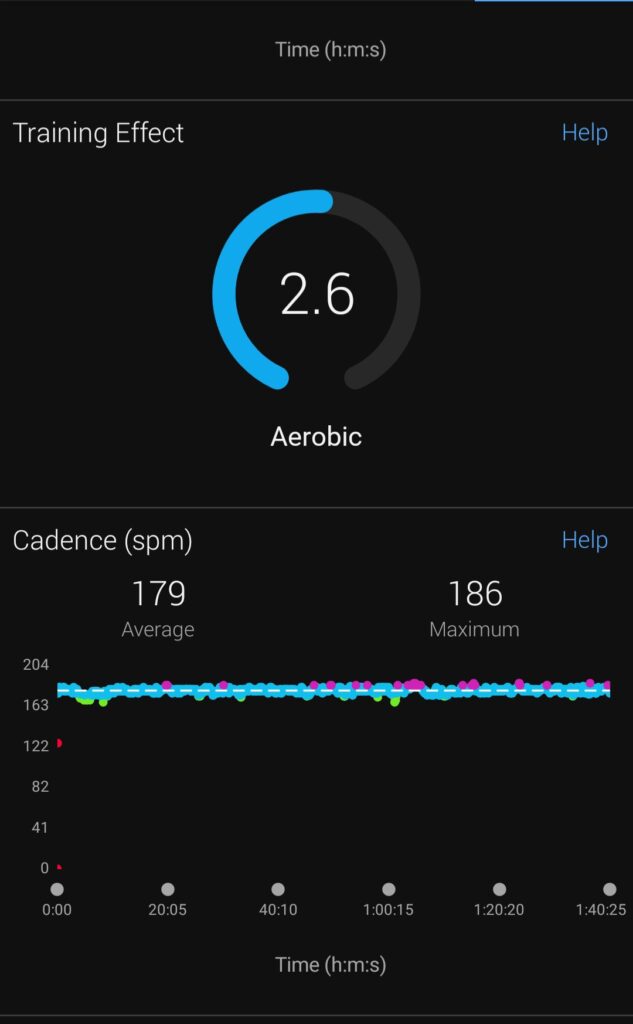
Figure 2: Training Effect (numeric score based on training zone), and cadence (in steps per minute)
In Figure 2, we see “Training Effect” – an assigned numeric score based on the duration spent in specific training zones – this has to do with average heart rate. Both this number and the graph representing heart rate (see figure 1), are the 2 factors I typically neglect when I refer to the data on Garmin connect after a run as a result of the inaccurate heart rate monitor which influences this data. The second graph in figure 2 is the information that most interests me about my runs. Cadence is another way to say “stride frequency” or simply “number of steps per minute.” Typically, for an easy run, I want to be close to ~180 steps per minute (this run I averaged a cadence of 179 spm, so pretty good!). This is where I feel I am moving the most efficiently and ultimately reducing the risk of injury. On harder runs, my cadence is typically closer to ~185 to 190 spm.
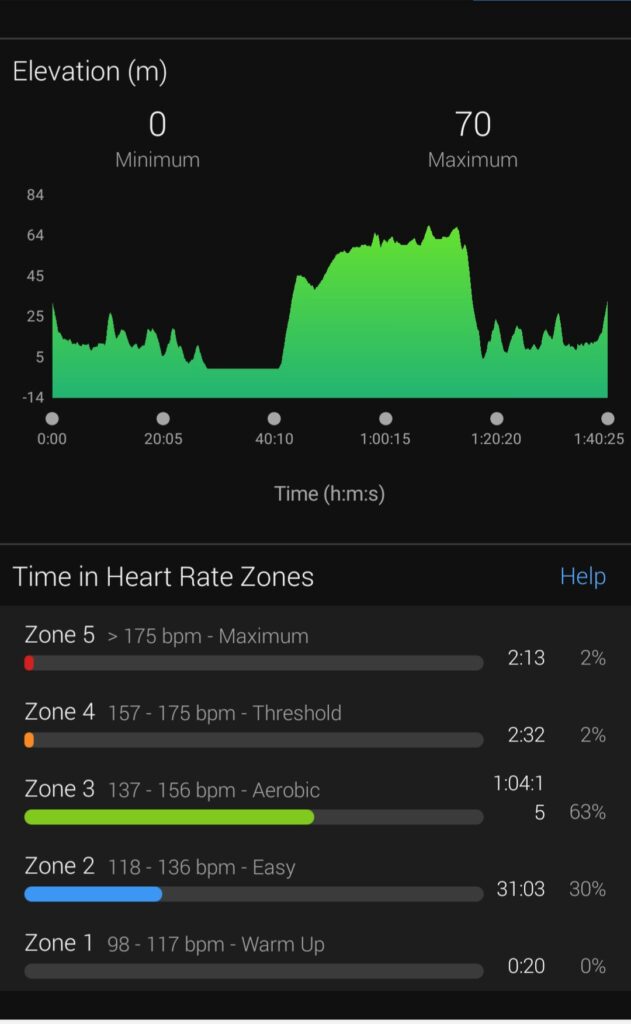
Figure 3: Elevation profile (in meters), and time spent (in minutes) in training zones
Figure 3 shows an elevation profile (altitude in meters with respect to time throughout my run) in the first graph, and time in heart rate zones in the second diagram (once again, as this information is based on data collected from an inaccurate heart rate monitor, I don’t pay too much attention to this). I really like to look at the elevation profile of my runs. I think the hillier the run, the better because it adds variety to your run, trains different groups of muscles (whether going up, or down, or flat) and it fluctuates the effort level. A “varied” run provides more physical stimulus, making it more challenging, but it also makes it harder to “overdo it” reducing the risk of injury!
Evidently, there are some data points that this platform collects which are negligible do to the inaccuracies of the heart rate monitor, for example. However, that is not to say that Garmin Connect is not an excellent tool. To me, there is a lot of valuable information that Garmin gathers during a run and I love to be able to refer to this data on my Garmin Connect in order to see patterns in my training progress. For example, I’ve realized that I feel better AND run better when my cadence is good (~180 spm for easy runs) and this is often a positive correlation with an increase in fitness, speed, and consistency! These are patterns I like to see in my training, and it is awesome to have a tool to be able to record/reflect on this data!
Technology is an excellent resource and it is especially useful from an educative point of view. Thanks to technology, we have access to resources unlike ever before. Technology speeds up the “process” – in every sense of the word. As a result of technological advances, students no longer have to go to libraries to look for the books that have the most suitable knowledge for their research. Being able to go online and use the tools available to conduct research allows students to focus on their learning rather than waste time looking for the appropriate resources. Furthermore, technology increases the accessibility of education, which became pretty clear during the past few years!
Two of our Ed-Tech classes this September were conducted over Zoom – a program which enables virtual learning with the use of a technological device such as a computer, a tablet, or a mobile phone. Zoom is a wonderful educative resource as it includes audio and visual functions to allow a group of people who are not physically in the same space to connect and learn together. This is especially useful when, due to any potential circumstances, people cannot physically be together to learn.
The pandemic, which has had an exceptional influence over the educative strategies and methods of delivery for the past few years, has forced us to learn virtually in situations where we cannot safely meet in person in a group setting without the risk of viral spread. Programs like Zoom, which are still widely being used, are incredibly helpful in such instances, and make learning with other people possible. It would be much more difficult to be a student in an era in which technology was not nearly as advanced as it is now trying to navigate self-taught learning as a result of a life altering circumstance such as a global pandemic. For this reason, I’m incredibly grateful to be able to use and benefit from the advances in technology. Not only does technology provide us with several resources to learn, it increases the number of ways in which people can continue to learn when things don’t go to plan. It allows us to be adaptable, which we need to be to learn!
After the first EDCI 336 class of the year, we watched the film “Most Likely to Succeed.” It was a film which described the method in which the students are taught and how they learn at the school, and it showed students working on their projects that would be on display at their year-end showcase.
I think the way the school is run is really cool. The open-ended, project based approach to learning encourages students to be creative with their work, and I think having a year-end showcase to put their learning on display for their parents could make them more passionate about their work and determined to succeed. They take pride in their work – and that is evident from the film footage which showed interviews with the students and clips of them being fully immersed in their work. Students are also working in groups to complete their projects; this increases their skills in communication, leadership, and open-mindedness to different ideas, as well as improving their ability to benefit from team work and be valuable team contributors. Evidently, they gain important skills which will support them in their careers and their lives outside of high-school.
While I think there are many positives to the approach to learning and teaching at High Tech High, I have a few reservations about how effective this learning approach may be. I love the creative approach; I’m an advocate for creativity in all aspects of life, and I think integrating creative expression in the classroom is a wonderful method to increase academic exploration and encourage curiosity, interest, passion, and different methods to represent learning. However, I think that there is a potential chance that students may miss out on aspects of the learning outcomes if they are focused on project-based learning. If students are focused on their own projects to demonstrate their learning, what if the steps that are required to complete their projects bypass some of the curriculum standards? I could imagine this happening for mathematics and physics, where it may be more challenging to represent equations and theories with a project based learning approach. In those instances, I think having a project/experiment needs to be supplemented with a more formal/traditional written report where students demonstrate and reflect on their learning with equations and some original written thoughts to articulate their ideas. Overall, I think having a balance of classic evaluation methods with clear learning outcomes and project-based learning where students have creative freedom with the way in which they would like to reflect their learning would be a better approach.
I am really glad we watched this film so early on in the semester. I think it gave great perspective on the different ways of teaching and how students can represent their learning. It definitely made me reflect on the type of teacher I would like to be and what types of projects/assessments I would like to give my students to ensure they are meeting the prescribed learning outcomes, but are also engaging with their work and enjoying the process.
Having a balanced training program is so important for many reasons. For one, it adds variety to your training week; it makes training sessions more fun when you aren’t doing the same thing day after day! Plus, a varied training program is a balanced training program. I think balance is the most important aspect of any training plan, especially when the training being done is very long and repetitive, such as long distance running! Not only will a balanced training program help to prevent injuries, it will help you improve, too! Exposing yourself to different physical stimuli with a variety of specific sessions is a great way to keep training exciting and get the most out of your week. In this blog entry, I will outline the various sessions I complete throughout the week which keep me motivated, happy, and improving!
Easy Runs
Easy mileage takes up about 75 – 80% of my training week – between warm up runs, cool-down runs, recovery runs, and long easy runs – every run day I’m running easy at some point! I try to define an easy run by a feeling rather than a pace. For example, if I am extra tired from school or work or a hard run, my easy pace will be slower than if I am fresh and well-rested. Easy runs are a great opportunity to explore a new run route, have a nice conversation with a friend, or just zone out and enjoy accumulating easy kilometers!
Long Runs
The long run is quite self-explanatory – it is your longest run of the week! Normally, I complete one to two long runs per week. I typically run them at an easy pace, but sometimes I incorporate faster paces for portions of my long run (see below- progression runs). The training purpose of long runs is to build up endurance and durability. I’ve raced a range of distances as short as 800 m to as long as a half marathon (21.1km), and I’ve found the long run to be an integral part of my training plan in all of those distances!
Threshold Runs
These are run at the threshold of comfort. If you are trying to define your threshold pace, it is as fast as you can run before your breathing changes over from controlled, representative of an “aerobic” effort, to labored, or entering the anaerobic zone. Another way to describe a tempo run is as the fastest run pace you could maintain for 60 minutes. However, depending on your training goals, the pace and the workout can be adapted to reflect varying distance/intensity. For example, a session such as 4 x 8 minutes hard with 2 minutes easy jog between hard reps could be run at a pace you could maintain for 30-40 minutes; you can increase the intensity of the session while remaining in the aerobic/threshold zone because the jog break gives your body the chance to recover from the harder effort. My favorite threshold workout is anywhere from 30-50 minutes continuous at a steady pace.
Progression Runs
Progression runs are one of my favorite sessions. They are typically longer runs, but the idea is to pick up the pace as the run goes on. So, by the end, you are running the fastest pace of the entire run. They are a great way to practice running fast and efficient while fatigued. Progression runs are also a great opportunity to practice pacing and patience; a great set of skills to have if you enjoy competing in longer distance races!
I have chosen to explore the topic of Long Distance Running for my Free Inquiry Project. Running has been a passion of mine since I was a young elementary school student. My journey as a runner began when I was 8 years old where I was introduced to the sport of athletics as a participant in school cross-country and track. If I reflect upon my feelings about running back then, while I definitely enjoyed it, I wouldn’t have imagined that it would grow to become such an influential part of my life today.
Running is a big part of my identity and within my mind I can easily make a connection between my running and everything else I do in my life. For example, I love math, physics, and statistics, and during/after my runs I love to consider the more data based/analytical aspects of my runs, such as pace and run cadence, and compare the statistics with my other runs. My run time is also when I consider reflective themes, and hence a lot of my creative thinking for my other passions, such as listening to music, writing and learning foreign languages, occurs during the tens of minutes I spend running each day. I think of my week in terms of my different training runs each day, and it is the driving force that motivates me to get through challenging weeks, such as when the schoolwork load is high.
While running is my passion and the source of greatest joy and fulfillment in my daily life, I recognize that running is not for everyone. It is an acquired taste activity, and it takes determination, dedication, motivation, and commitment to discover the joy and the satisfaction that a consistent running routine can provide. My free inquiry project will outline the elements that inspire and motivate me to run everyday, from variety in training to mindset, and I hope to encourage others to find joy in running through my blog posts!